Natural disasters such as earthquakes, hurricanes, and floods occur frequently worldwide, rendering building safety a paramount consideration for overseas developers and investors. When selecting a building structure, its disaster resistance directly determines the safety of life and property, as well as long-term investment value. Traditional masonry buildings often fail to withstand extreme disasters effectively, resulting in severe structural damage and substantial economic losses. High-strength light steel villas, featuring advanced structural design and high-performance materials, have gradually emerged as a preferred option for disaster-prone regions. However, a critical question persists: Are high-strength light steel villas truly safer in mitigating disaster risks?
Drawing on authoritative test data, international certification standards, and global practical application cases, this article explores the disaster resistance capabilities of high-strength light steel villas, supplemented by a detailed comparative parameter table, to offer professional, reliable guidance for overseas clients.
The disaster resistance of high-strength light steel villas is derived from their scientific structural design, high-quality material selection, and stringent manufacturing standards. Unlike traditional rigid structures, they adopt a flexible yet robust design philosophy, which enables effective absorption and dispersion of disaster-induced energy, thereby minimizing structural damage.
Earthquakes pose the most significant threat to building safety, and the core of earthquake resistance lies in a structure’s ability to absorb seismic energy. High-strength light steel villas utilize G550 high-strength cold-rolled steel frames with a yield strength of ≥550MPa, integrated with a ribbed frame and skin structure to form a complete, stable force-bearing system. The overall weight of the building is merely 1/5 that of traditional masonry structures, which significantly reduces inertial force during seismic activity and minimizes impact on the foundation. Authoritative tests indicate that high-strength light steel villas can resist earthquakes up to magnitude 9 and seismic intensity 9 degrees, with the structure only generating recoverable elastic deformation during seismic events, preventing rigid structural collapse and effectively safeguarding the safety of indoor occupants. In contrast, traditional masonry buildings rely on rigid load-bearing, making them prone to cracking and collapse when subjected to earthquakes above magnitude 7.
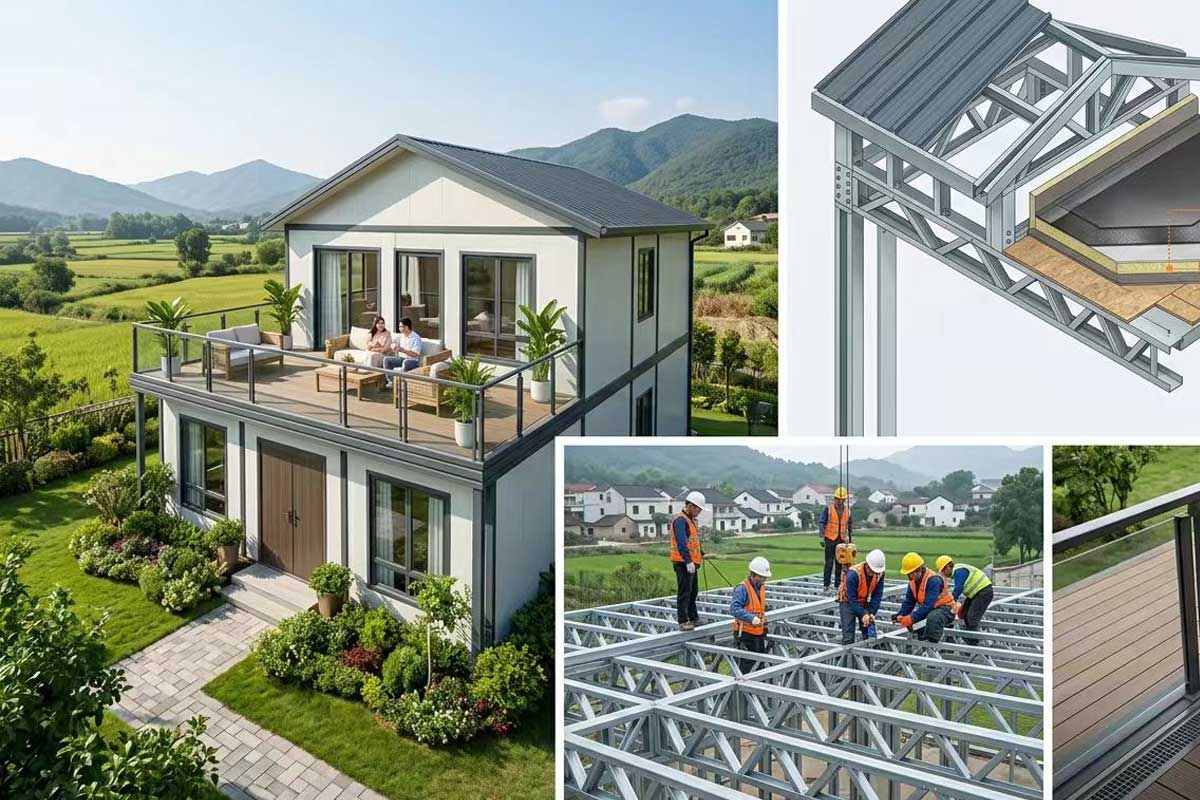
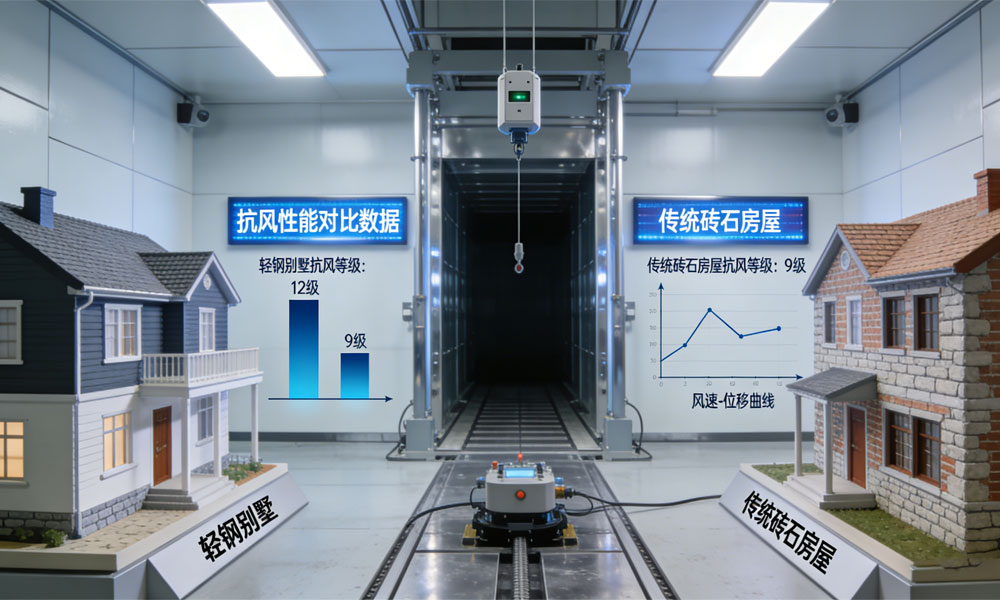
For coastal and typhoon-prone regions, wind resistance is a critical indicator of building safety. High-strength light steel villas adopt an integral frame design, with all components connected by high-strength bolts to form a seamless, unified structure that can evenly distribute wind pressure and prevent local structural damage. The aerodynamic roof design further reduces wind resistance, enabling the villas to resist hurricanes with wind speeds of up to 70 m/s (equivalent to level 16) without structural deformation. Professional laboratory simulation tests demonstrate that when wind speeds reach 32.7 m/s (level 12 typhoon standard), the main frame of high-strength light steel villas remains intact, with only slight vibration observed on external wall panels. Traditional masonry buildings, by contrast, are prone to wall cracking and roof collapse under strong wind conditions.
Disaster resistance also encompasses long-term durability in harsh environmental conditions. Components of high-strength light steel villas undergo hot-dip galvanization treatment, with a zinc layer thickness of ≥275g/㎡, enabling them to pass the SGS salt spray test for over 3000 hours and effectively mitigating corrosion caused by salt fog, moisture, and other environmental factors. This makes them particularly suitable for coastal and humid regions, preventing structural damage resulting from long-term corrosion. Additionally, the combination of moisture-proof, breathable membranes and calcium silicate boards prevents wall mold and mildew, ensuring structural stability in complex climatic environments. Traditional masonry buildings are prone to moisture absorption, cracking, and weathering, which gradually diminish their disaster resistance over time.
Disaster Type & Parameter | High-Strength Light Steel Villas | Traditional Masonry Buildings | Safety Advantage |
|---|---|---|---|
Earthquake Resistance | Up to Magnitude 9, Intensity 9 | Up to Magnitude 7, Intensity 7 | 2-3 times stronger seismic resilience |
Wind Resistance (Wind Speed) | Up to 70 m/s (Level 16 Hurricane) | Up to 30 m/s (Level 11 Typhoon) | Withstands extreme winds without deformation |
Salt Spray Corrosion Resistance | SGS Test ≥ 3000 Hours | ≤ 500 Hours | 6 times better corrosion resistance |
Structural Deformation Recovery | Recoverable Elastic Deformation | Permanent Rigid Damage | Minimizes post-disaster repair costs |
Foundation Load Requirement | Low (1/5 of masonry) | High | Reduces foundation collapse risk in disasters |
Fire Resistance | 1-4 Hours (Customizable) | ≤ 1 Hour | Provides more escape time in fire disasters |
The disaster resistance of high-strength light steel villas is not only corroborated by test data but also recognized by international authorities. All components comply with international standards such as ASTM A653, EN 1090, and JIS A 4706, and have obtained CE, ISO 9001, and SGS certifications, ensuring compliance with building safety regulations in most countries and regions worldwide. From post-disaster reconstruction projects in earthquake-prone areas such as Japan and California to coastal resort projects in Southeast Asia, high-strength light steel villas have consistently exhibited superior disaster resistance, with a building integrity rate of over 92% in disaster-affected areas—far exceeding the 67% integrity rate of traditional masonry buildings.
For overseas developers and investors, selecting a building structure with strong disaster resistance is equivalent to mitigating long-term risks and safeguarding investment value. High-strength light steel villas, with their flexible yet robust structure, high-performance materials, and rigorous quality control, have been proven to be safer than traditional buildings when confronting natural disasters. Therefore, when evaluating disaster resistance capabilities, can the advantages of high-strength light steel villas be overlooked? The answer is unequivocally negative—they represent a reliable choice for safe, durable overseas construction projects.
 Follow us