With the continuous deepening of Sino-African cooperation in green construction, light steel villas have become a core product category for Chinese enterprises to explore the South African market, thanks to their advantages of efficient construction, environmental protection, energy saving, and strong scene adaptability. As one of the countries with the most improved construction industry standards in Africa, South Africa has established a strict market access system and certification supervision requirements. If light steel villas exported to South Africa lack corresponding certifications or the certifications do not meet local standards, they will not only fail to complete customs clearance smoothly but also may face risks such as cargo detention, heavy fines, and return and destruction. Based on local certification standards and industry practical experience in South Africa, Hanliang Ruijie systematically analyzes the core certification requirements for exporting light steel villas to South Africa and clarifies compliance key points.
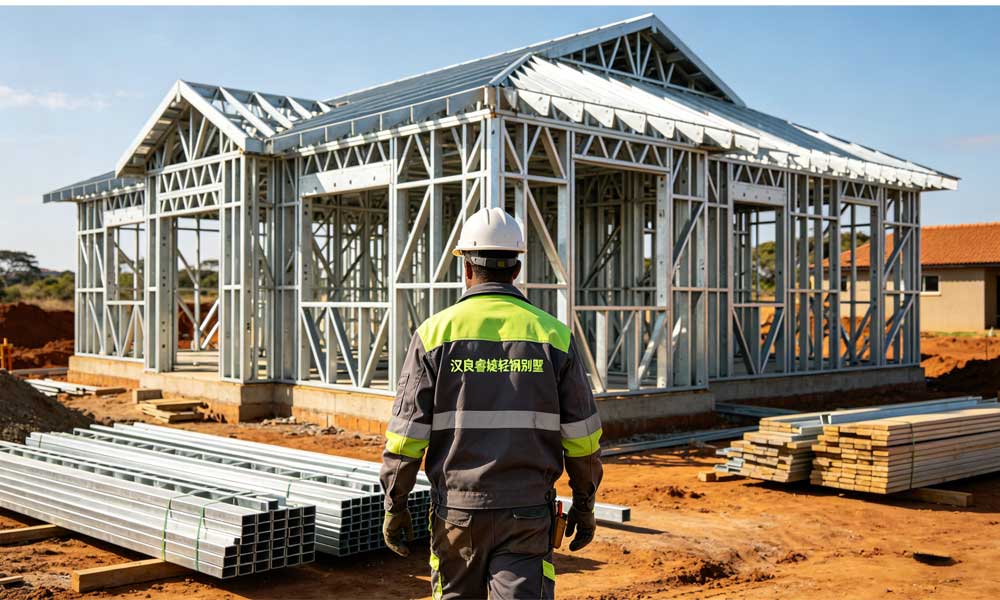
The first requirement for exporting light steel villas to South Africa is to obtain NRCS certification. Implemented by the National Regulator for Compulsory Specifications (NRCS) of South Africa, this certification is a mandatory certification and an essential access document for light steel villas to enter the South African market. Products without this certification cannot complete the customs clearance process. The core goal of NRCS certification is to ensure that products comply with local mandatory standards for safety, health, and environmental protection. As a construction product, light steel villas have been clearly included in the NRCS mandatory certification catalog, and enterprises must complete the full certification process in accordance with standards.
It is important to note that NRCS certification requires the submission of a complete set of technical documents, including product design drawings, material test reports, and English user manuals. Some building material components need to undergo supplementary testing in designated laboratories in South Africa, focusing on key indicators such as steel durability and fire performance. After the certification is approved, the enterprise will obtain a Letter of Authority (LOA) certificate, which is valid for 3 years. During the validity period, annual inspections will be conducted, and the certificate must be renewed 6 months before expiration; otherwise, the compliant access qualification will be lost. In addition, products must be affixed with a label containing the NRCS registration number, with a font height of not less than 3mm, to avoid the risk of non-compliance during market inspections due to irregular labeling.
SABS Certification (South African Bureau of Standards Certification) is the most authoritative third-party certification in South Africa, divided into mandatory and voluntary categories. For light steel villas exported to South Africa, this certification is usually a necessary item, especially when docking with South African government bidding projects and large-scale engineering projects. SABS certification is the core endorsement for product quality compliance and an important advantage for enterprises to participate in market competition. Issued by the South African Bureau of Standards (SABS), this certification covers multiple core dimensions such as the main structure of light steel villas and building material quality, and must strictly comply with the relevant requirements of South African National Standards (SANS).
To apply for SABS certification for light steel villas, three core conditions must be met: the product complies with the corresponding SANS standards (e.g., steel must comply with SANS1431 standard), passes product testing by SABS-accredited laboratories, and the production factory meets the requirements of the ISO 9001 quality management system. The certification process consists of four consecutive stages: application submission, factory inspection, sample sampling inspection, and certificate issuance, with a cycle of usually 3-6 months. Enterprises need to plan the certification time in advance to ensure it does not affect the export progress. It is worth noting that products that have obtained the SABS Mark (voluntary mark certification) must be affixed with the SABS mark in accordance with standards, which can significantly improve the recognition and competitiveness of products in the South African market.
If light steel villas exported to South Africa are used for green building projects, high-end residential projects, or key government projects, GBCSA green building certification will become a key condition for project access, transforming from a compliance bonus item to a necessary access requirement. Launched by the Green Building Council of South Africa (GBCSA), GBCSA certification is an authoritative certification in the field of green buildings in South Africa. Its core goal is to promote the sustainable development of the construction industry, and the certification level directly determines whether products can enter the high-end project supply chain system.
To apply for GBCSA certification for light steel villas, focus must be placed on three core dimensions: environmental protection, energy saving, and sustainability, including the use of recyclable building materials, optimization of thermal insulation design, and supporting rainwater collection systems. At the same time, complete environmental testing reports, energy consumption evaluation reports, and other relevant documents must be provided. The certification is divided into four levels; the higher the certification level, the stronger the competitiveness of the enterprise in project bidding. For enterprises planning to long-term cultivate the South African market and layout the high-end green construction field, completing GBCSA certification in advance can effectively seize market opportunities and enhance brand influence.
In addition to the above core certifications, a series of auxiliary certification documents must be prepared for exporting light steel villas to South Africa. Although these documents are auxiliary links, they directly affect the efficiency of customs clearance and project acceptance progress. First, the Certificate of Conformity (COC), which must be issued by an organization accredited by SABS or NRCS to prove that the product complies with relevant local standards in South Africa. It must follow the principle of "one certificate per shipment" and cannot be used across batches or goods. Second, the material test report, which focuses on key indicators such as the coating thickness of light steel keels, the combustion performance of fireproof rock wool, and the anti-corrosion level of fasteners, must be issued by an ILAC-accredited laboratory to ensure the authority of the test results.
In addition, all technical documents (including certification certificates, test reports, and user manuals) must be uniformly translated into English to avoid document review rejection due to language inconsistency. If the product involves wooden auxiliary materials, an additional anti-corrosion and anti-termite treatment report must be provided to ensure compliance with relevant local termite prevention and control requirements in South Africa. Enterprises need to sort out all documents in advance to ensure no omissions or deviations, and retain test records for at least 5 years for inspection and verification by South African market supervision authorities.
In summary, exporting light steel villas to South Africa requires focusing on implementing the two core mandatory certifications of NRCS and SABS, preparing GBCSA green certification and various auxiliary documents as needed according to project requirements, while strictly following relevant local standards and labeling requirements in South Africa.
Q1: Can light steel villas exported to South Africa complete customs clearance with only NRCS certification?
A1: Yes, customs clearance can be completed. NRCS certification is the mandatory core certification for South African market access and an essential document for product customs clearance. As long as the NRCS certification is compliant and the documents are complete, the customs clearance process can be completed smoothly. However, it should be noted that when docking with government bidding or large-scale engineering projects, SABS certification is usually required additionally; otherwise, it may affect project access.
Q2: What is the core difference between SABS certification and NRCS certification?
A2: The two have different core positioning: NRCS certification is a mandatory access certification, whose core role is to ensure that products comply with local mandatory safety and environmental protection standards, focusing on "whether they can enter the market"; SABS certification is a third-party quality certification, divided into mandatory and voluntary categories, whose core role is to endorse product quality, focusing on "improving market competitiveness", and is an important support for docking high-end projects.
Q3: If the indicators are unqualified after submitting the certification documents, can the application be re-submitted after supplementary rectification?
A3: Yes. For both NRCS certification and SABS certification, if the test indicators are unqualified, enterprises can optimize product design, improve test indicators, and re-submit the application with supplementary documents in accordance with the rectification opinions issued by the certification body until the certification is approved. It is recommended that enterprises conduct self-inspection in advance before applying to reduce rectification time and avoid affecting the export progress.
 Follow us